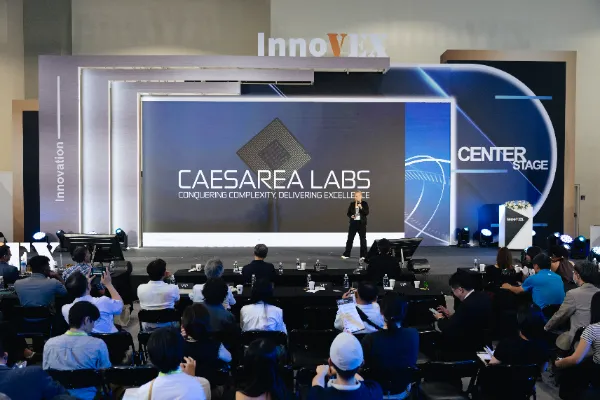
Reduce the Complexity of Post-silicon Validation with Caesarea Las
Caesarea Labs is an Israel-based startup focusing on semiconductor electronic design automation (EDA) for post-silicon validation labs. As one of the winners of the IC Taiwan Grand Challenge Batch 4 in the Smart Manufacturing category, Caesarea Labs is building the first end-to-end automation of the Circuit Edit workflow and has recently acquired Panasonic's Digital Privacy Patent (US9946894B2), to facilitate a secure chip IP transfer to and from its prospective customers.
Chip Development Delayed by Vital Processes
Recent tech development has highlighted how vital semiconductors are for the modern world. The demand for semiconductors and their complexity has been further increased by the rapid development and deployment of AI, as new systems and applications require more complex semiconductors. However, semiconductor companies might not be perfectly capable of managing the increasing complexity of testing advanced chips. Chip complexity has surpassed the level at which chips can be manually tested reliably at the Post Silicon Validation stage. Currently post-silicon validation is expensive, inaccurate, and time consuming due to the lack of dedicated, specialized EDA software. It is generally understood that at the current stage, EDA companies don't have insider knowledge of the post-silicon validation segment, while chip developers do not have EDA expertise and neither of them are focused on post-silicon validation EDA solutions.Caesarea Labs aims to solve this bottleneck with the first end-to-end automation of the Circuit Edit workflow by transforming it into a reliable, software-driven workflow.
Introducing IC Taiwan Grand Challenge
To strengthen Taiwan's position as a global semiconductor powerhouse, the National Science and Technology Council (NSTC) organizes the IC Taiwan Grand Challenge. Started in 2024, the competition originally focused purely on innovative IC designs and advanced application solutions. Today, ICTGC also honors teams in the fields of AI Core Technologies and Chips, Smart Mobility, Smart Manufacturing, Smart Medtech, and Sustainability, which can support and contribute to the semiconductor industry and Taiwan’s industry in general. Caesarea Labs was selected as one of the winners in the Smart Manufacturing category with their Circuit Edit automation technology that represents a fundamental shift from artisanal, expert-dependent circuit editing to scalable, machine-assisted execution.
Circuit Edit Automates Translation of Validated Semiconductor Design
Established in 2023 by former Intel engineers, Caesarea Labs brings modern EDA automation to post-silicon validation, an often overlooked but critical stage in semiconductor manufacturing. They are building the first end-to-end automation of the Circuit Edit (CE) workflow with the goal of providing automated translation of solution hypotheses at the schematic-level into layout-level CE designs, while eliminating manual layout navigation and annotation and enabling advanced 2D/3D visualization of edits directly within the chip database. Their innovation also aims to empower AI-assisted CE design generation, scoring, and alternative exploration.
By transforming Circuit Edit from an iterative, human-intensive translation of debug hypotheses into physical silicon modifications into a reliable, software-driven workflow, Caesarea Labs’ platform systematically converts design intent and lab constraints into optimized, layout-level edit instructions in seconds. This is a fundamental shift from the conventional artisanal, expert-dependent circuit editing to a scalable, machine-assisted execution. By bridging EDA methodologies with physical FIB-based modification environments, the technology industrializes a discipline that has historically resisted automation, enabling higher success rates, reduced cycle times, and increased lab throughput at advanced process nodes.